Arabic Legal Translation Near Me in UAE: Ministry of Justice Certified Document Services
1. Executive Summary: The Statutory Supremacy of Arabic in the UAE Legal System
The United Arab Emirates represents one of the world's most dynamic commercial and expatriate hubs, home to more than two hundred nationalities operating across global trade, real estate, energy, finance, and technology. However, while English serves as the lingua franca of multinational commerce and offshore financial centers, Arabic remains the sole official language of the United Arab Emirates under Article 7 of the UAE Constitution and Federal Law No. 11 of 1992 (as amended by Federal Decree-Law No. 42 of 2022 on the Civil Procedures Law).
Every public department, governmental ministry, onshore judicial court, police authority, and municipal licensing body across the seven Emirates mandates that official documentation submitted by corporate entities and private individuals must be presented in verified, legally authenticated Arabic. Whether you are searching for Arabic legal translation near me to execute an urgent commercial contract, sponsor family members through the General Directorate of Residency and Foreigners Affairs (GDRFA), submit an evidentiary bundle to the Dubai Courts, or notarise a corporate Power of Attorney before the UAE Notary Public, uncertified or machine-generated translations are summarily rejected.
Under Federal Law No. 6 of 2012 regarding the regulation of the translation profession, legal translations in the UAE can only be certified by licensed sworn translators who have passed rigorous judicial examinations administered by the Ministry of Justice (MOJ). Our accredited legal translation centers across Dubai, Abu Dhabi, and Sharjah provide court-ready, sworn Arabic legal translations that guarantee 100% statutory acceptance before all UAE federal and local government authorities. This master guide outlines statutory certification standards, MOFA attestation workflows, civil and commercial document requirements, name transliteration rules, and expedited delivery protocols tailored for corporate counsels, expatriates, and litigation attorneys across the UAE.
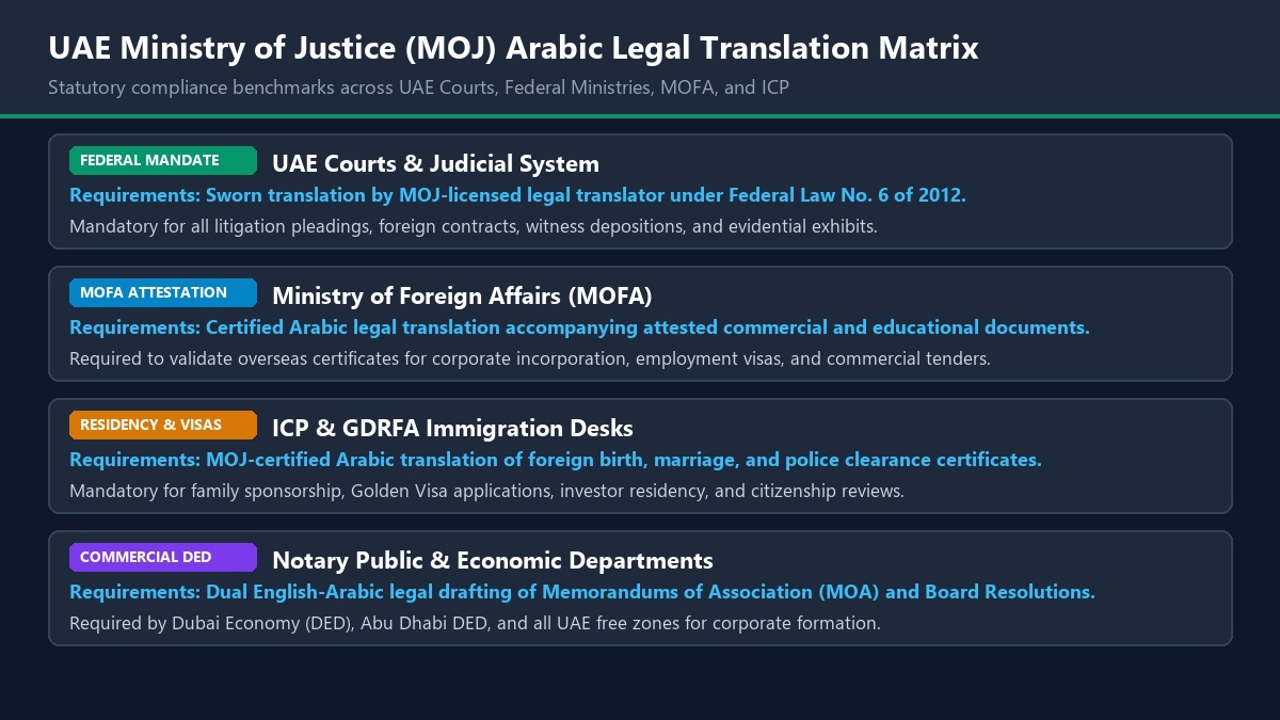
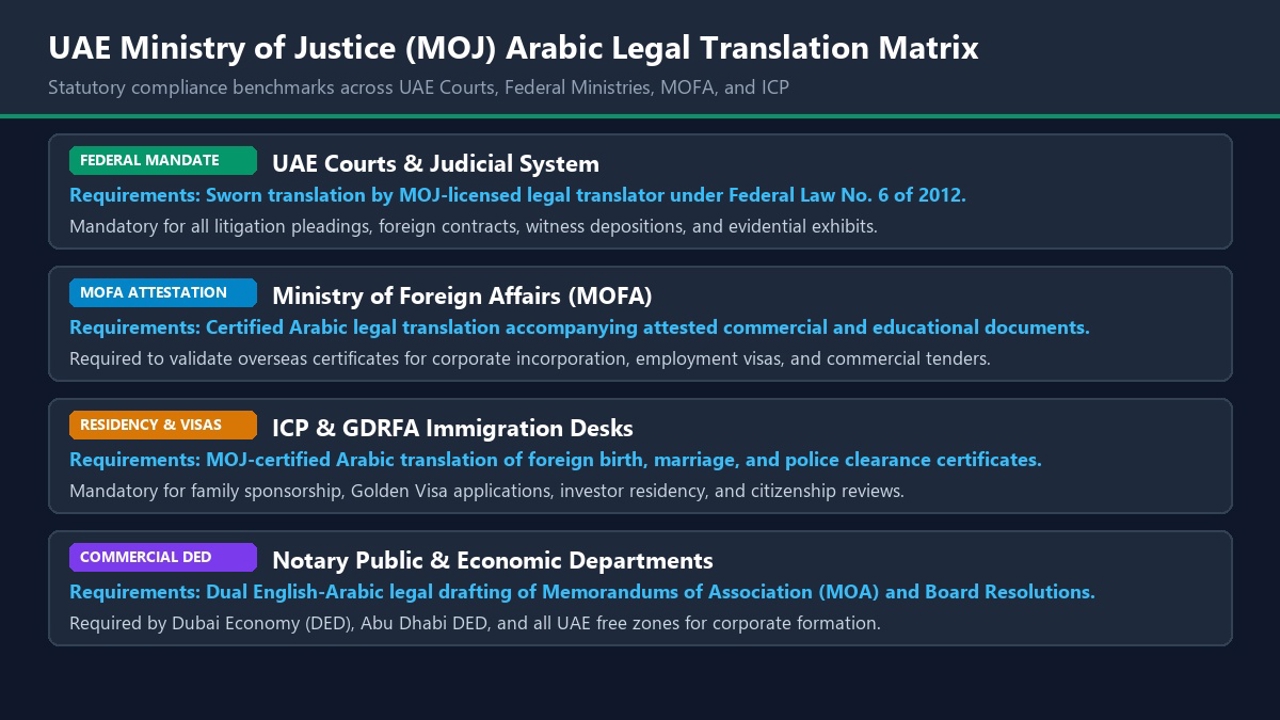
Figure 1: Statutory compliance matrix governing official Arabic legal translations across UAE Federal Courts, Ministry of Foreign Affairs (MOFA), GDRFA immigration desks, and municipal economic departments.
2. Federal Law No. 6 of 2012: The Statutory Framework Governing UAE Sworn Translators
In the UAE, the profession of legal translation is an officially regulated judicial office subject to strict administrative oversight, statutory licensing, and civil and criminal liability. Understanding the legal standing of sworn legal translators is essential when selecting a translation provider.
A. Licensing, Examinations & Judicial Oaths
Under Federal Law No. 6 of 2012 concerning the Regulation of the Translation Profession, individuals seeking to practice legal translation must satisfy rigorous state criteria:
- Judicial Accreditation Examinations: Candidates must hold recognized university degrees in translation or linguistics and pass comprehensive written examinations conducted by the Ministry of Justice, testing deep competence in UAE civil transactions law, penal code terminology, commercial contract drafting, and procedural court rules.
- Judicial Swearing of the Oath: Successful linguists take a formal judicial oath before the Minister of Justice or the President of the Federal Court of Appeal, swearing by Almighty God to perform their duties with absolute honesty, accuracy, and fidelity to the law.
- Official License Registration: Each sworn translator is issued a unique MOJ License Registration Number and an official corporate stamp containing their full legal name, certified language pair (e.g., English to Arabic, French to Arabic, German to Arabic), and authorized signature.
B. Statutory Legal Liability for Inaccurate Translations
Unlike unregulated jurisdictions where translation errors are treated merely as private contractual breaches, under Article 28 of Federal Law No. 6 of 2012, a sworn legal translator in the UAE faces professional license revocation, heavy civil fines, and criminal prosecution under the UAE Penal Code if they knowingly or negligently certify an inaccurate translation that alters the legal rights, contractual liabilities, or court testimony of litigants.
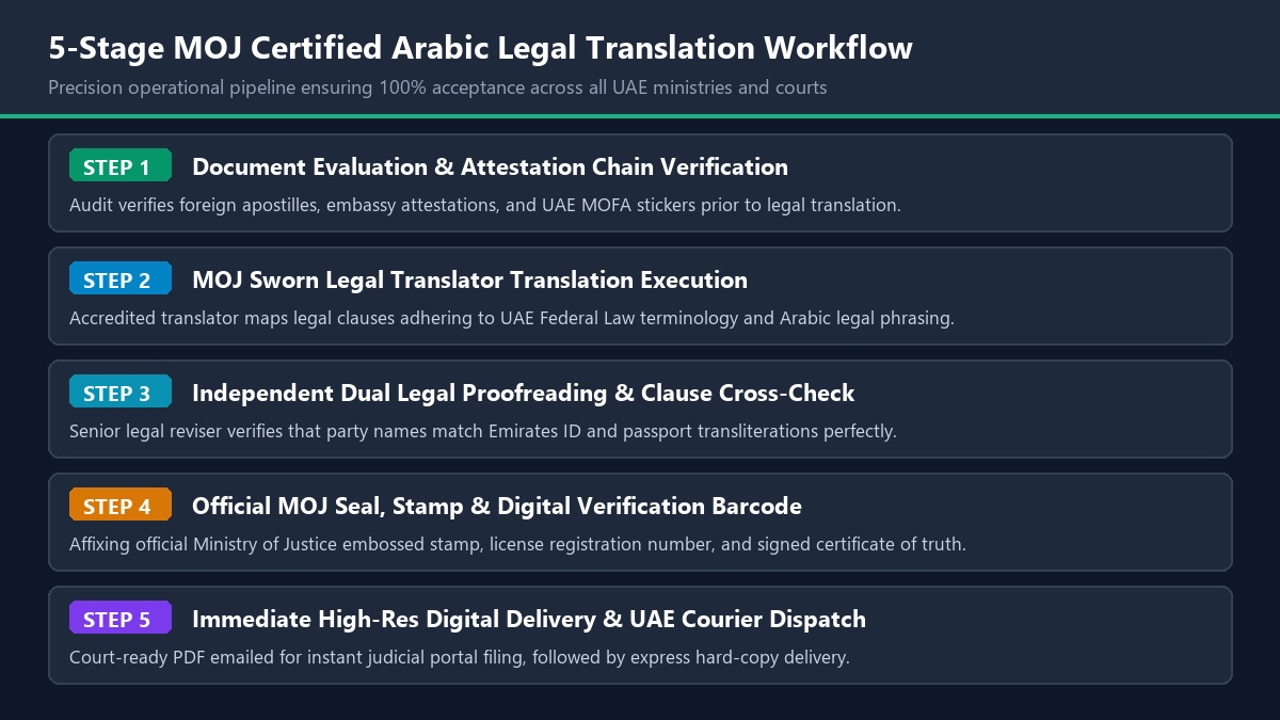
Figure 2: The Lang247 UAE 5-stage legal translation workflow: document attestation review, MOJ sworn translator drafting, independent legal proofreading, official MOJ stamping with barcode verification, and rapid courier delivery.
3. The 4-Stage Document Attestation Chain: Originating Country to UAE MOFA
A frequent administrative misconception among expatriates and foreign investors is assuming that a foreign document can simply be translated into Arabic immediately upon arriving in the UAE. Under UAE consular regulations, any foreign public or commercial document must complete the full international chain of consular legalisation before the Ministry of Justice legal translation can be certified.
| Attestation Stage | Executing Authority | Location of Execution | Mandatory Verification Purpose |
|---|---|---|---|
| Stage 1: Primary Authentication | Notary Public / Vital Statistics Registrar / University Registrar | Country of Document Origin (e.g., UK, USA, India, France) | Certifies the genuineness of the document issuer's official signature and institutional seal. |
| Stage 2: Foreign Affairs Certification | Ministry of Foreign Affairs (e.g., UK FCDO, US Department of State, India MEA) | Capital City of Originating Country | Validates the notary public's commission or attaches an official Apostille certificate. |
| Stage 3: UAE Embassy Attestation | Embassy or Consulate General of the United Arab Emirates | Originating Country (e.g., London, Washington, New Delhi, Paris) | Diplomatic consular seal certifying the foreign ministry's signature for cross-border recognition. |
| Stage 4: UAE MOFA Attestation & MOJ Translation | UAE Ministry of Foreign Affairs (MOFA) & MOJ Sworn Translators | United Arab Emirates (Dubai, Abu Dhabi, Sharjah) | MOFA electronic QR attestation sticker, followed by official MOJ Arabic legal translation. |
When our team receives a document for Arabic legal translation, our forensic intake auditors inspect the reverse side of the original certificate to verify the presence of the UAE Embassy seal and MOFA electronic QR code sticker. Translating a foreign certificate before it has received the necessary diplomatic seals results in immediate rejection by UAE government departments.
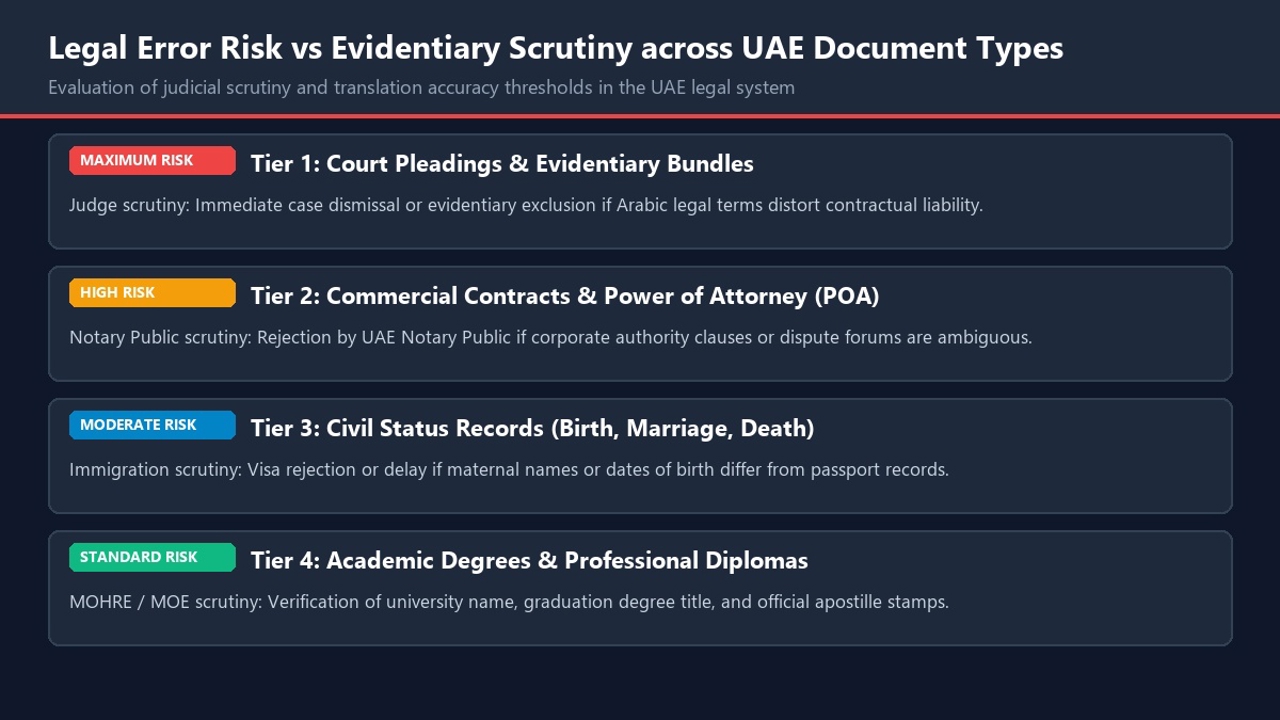
Figure 3: Evidentiary scrutiny and legal liability risk across UAE document tiers: court litigation bundles, commercial contracts and POAs, civil status certificates, and academic credentials.
4. Core Document Typologies: Commercial Contracts, Corporate Charters & Court Pleadings
Arabic legal translation encompasses distinct legal specialisms, each demanding mastery of specific statutory codes and procedural formats.
A. Commercial Contracts, Board Resolutions & Powers of Attorney (POA)
Under Federal Decree-Law No. 32 of 2021 on Commercial Companies, corporate formations, share transfers, and board resolutions must be drafted or translated into official Arabic before execution before the UAE Notary Public:
- Memorandums and Articles of Association (MOA / AOA): Standard corporate charters executed in English must feature a certified side-by-side Arabic translation. The Arabic text takes absolute statutory precedence in the event of judicial interpretation before UAE onshore courts.
- Special and General Powers of Attorney: Powers of Attorney originating overseas must be translated into Arabic with exact enumeration of agent authorities (such as signing bank facilities, selling real estate, or representing the principal before judicial authorities). Ambiguous English phrasing translated vaguely into Arabic will result in the UAE Notary Public or land department refusing to register the instrument.
- Commercial Agency Agreements: Foreign supplier agreements registered under Federal Decree-Law No. 3 of 2022 on Regulating Commercial Agencies require certified Arabic translations for formal registration with the Ministry of Economy.
B. Court Pleadings, Evidentiary Exhibits & Arbitration Bundles
Litigation before the Dubai Courts, Abu Dhabi Judicial Department, Sharjah Courts, and Federal Courts of First Instance and Appeal requires all evidential submissions to be in Arabic:
- Claim Statements and Defense Memorandums: Legal briefs drafted by advocates citing UAE Civil Transactions Law (Federal Law No. 5 of 1985) and Commercial Transactions Law (Federal Decree-Law No. 50 of 2022).
- Technical Accounting & Expert Witness Exhibits: Financial ledgers, engineering dispute reports, bank statements, and email correspondence between commercial parties must be translated completely into Arabic by MOJ-certified translators before court-appointed judicial experts will admit them into evidence.
- Enforcing Foreign Arbitral Awards (New York Convention 1958): To ratify and execute an international arbitral award (ICC, LCIA, SIAC) onshore in the UAE, the claimant must submit a certified Arabic translation of both the final award and the original arbitration agreement under Federal Law No. 6 of 2018 on Arbitration.
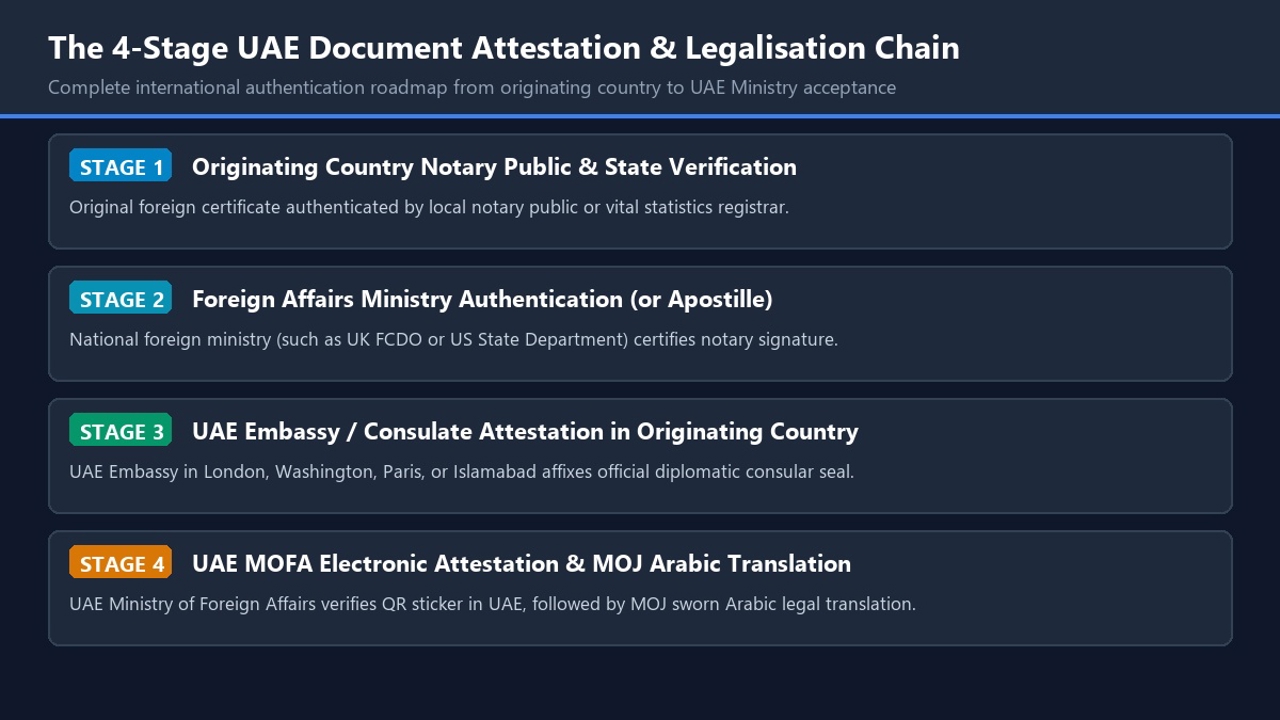
Figure 4: Complete international authentication roadmap: originating country notary public, national foreign affairs certification, UAE Embassy diplomatic seal, and UAE MOFA electronic attestation.
5. Personal Status & Civil Residency Documents: Visas, Golden Visas & Family Sponsorship
Expatriates relocating to or residing within the United Arab Emirates frequently require certified Arabic legal translations of personal status certificates to satisfy GDRFA and ICP immigration requirements.
A. Family Visa Sponsorship (Spouse, Children, Parents)
Under UAE immigration regulations, an expatriate employee or investor sponsoring family members for residency must present certified civil records:
- Marriage Certificates (Aqd Zawaj): Foreign marriage certificates must be fully attested and translated into Arabic by an MOJ sworn translator to prove legal spousal relationship before the GDRFA or Amer service centers.
- Birth Certificates (Shahadat Milad): Certified Arabic translations of children's birth certificates are mandatory to sponsor dependents under your visa and to enroll children in public and private schools under the Knowledge and Human Development Authority (KHDA) in Dubai and ADEK in Abu Dhabi.
- Relationship Dependency Affidavits: When sponsoring parents, expatriates must present certified translations of parental birth records and proof of sole dependency.
B. UAE Golden Visa & Green Visa Submissions
The UAE Golden Visa offers long-term 10-year residency for specialized talents, scientists, outstanding students, entrepreneurs, and real estate investors:
- Academic Degree Equivalency: Skilled professionals and PhD researchers applying for Golden Visas must obtain degree equivalency from the UAE Ministry of Education (MOE). This requires certified Arabic legal translations of bachelor's, master's, and doctoral degree certificates and full academic transcripts.
- Commercial Real Estate Title Deeds: Real estate Golden Visa applicants investing 2 million AED or more must ensure purchase agreements, title deeds from the Dubai Land Department (DLD), and mortgage clearance letters are certified in Arabic.
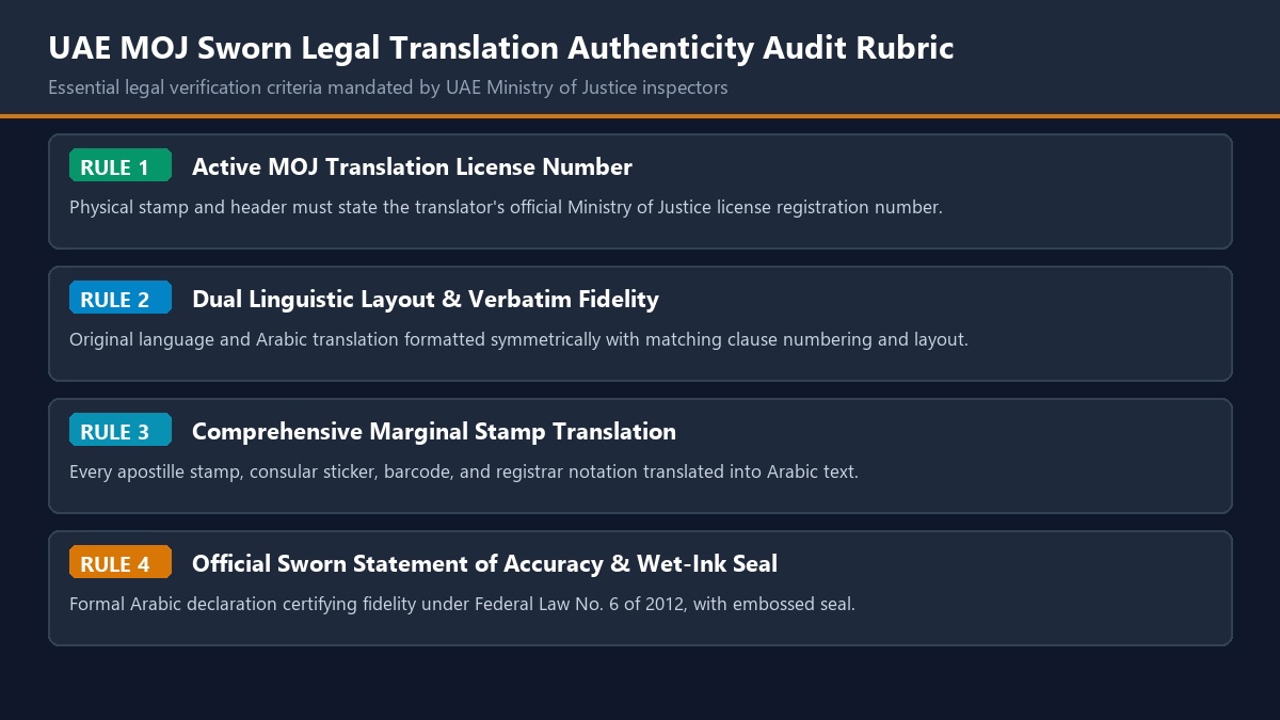
Figure 5: Judicial audit rubric applied by UAE court registrars and government inspectors: verified MOJ license number, symmetrical dual-language formatting, full marginal stamp transcription, and embossed sworn seal.
6. The Dual Judicial Framework in the UAE: Onshore Courts vs Offshore Free Zones
The United Arab Emirates maintains a sophisticated dual judicial architecture comprising onshore civil law courts and offshore English common law financial free zones. Understanding this distinction is vital for corporate litigators and legal practitioners.
| Judicial Jurisdiction | Legal Tradition | Official Working Language | Arabic Translation Requirements |
|---|---|---|---|
| Onshore UAE Courts (Dubai, Abu Dhabi, Federal) | Civil Law (codified based on Egyptian and French civil codes, informed by Sharia) | Arabic Exclusively | Mandatory for all pleadings, exhibits, contracts, and witness statements. Certified by MOJ sworn translator. |
| Dubai International Financial Centre (DIFC Courts) | English Common Law (precedent-based independent judicial system) | English Exclusively | Not required for internal DIFC court proceedings. However, a certified Arabic translation is mandatory to execute a DIFC judgment onshore through Dubai Courts. |
| Abu Dhabi Global Market (ADGM Courts) | English Common Law (direct application of English common law) | English Exclusively | Not required for internal ADGM filings. Certified Arabic translation required when enforcing orders through the Abu Dhabi Judicial Department. |
Under the conduit enforcement framework between the DIFC Courts and Dubai Courts (governed by Dubai Law No. 12 of 2004 as amended), parties often secure English-language judgments in the DIFC. To enforce those monetary judgments against onshore bank accounts or commercial assets located outside the free zone, the claimant must obtain an execution formula in Arabic certified by an MOJ sworn translator.
7. Name Transliteration Rules & Civil Identity Harmonisation with Emirates ID
Transliterating non-Arabic personal and corporate names into the Arabic alphabet represents one of the most frequent sources of bureaucratic delay and rejected visa transactions in the United Arab Emirates.
A. The Emirates ID and Residency Visa Alignment Rule
The Federal Authority for Identity, Citizenship, Customs and Port Security (ICP) maintains strict name databases. When an expatriate opens bank accounts, purchases property, or registers a commercial trade license, their legal identity in Arabic must correspond exactly with the Arabic name printed on their Emirates ID card.
When translating foreign certificates, our sworn linguists apply strict identity reconciliation:
- Clients submit a clear scan of the applicant's current Emirates ID card and passport alongside the foreign document.
- The translator ensures that the Arabic spelling of the applicant's name on the certified translation matches the existing Arabic name on their Emirates ID down to individual diacritical letters (such as distinguishing between Alif Maqsura 'ى' and Ya 'ي', or Hamza placements).
- If an applicant does not yet possess an Emirates ID (such as a first-time visa applicant entering the UAE), names are transliterated strictly following official ICP phonetical transliteration tables.
B. Corporate Trade Names & Commercial Registry Matching
Foreign multinational subsidiaries operating in the UAE must ensure that their translated parent company name matches their official commercial trade license registered with the Department of Economic Development (DED). Discrepancies between the Arabic trade license name and the Arabic name on translated parent board resolutions prevent corporate banking transactions and delay commercial lease renewals.
8. Turnaround Speeds, Pricing Models & Urgent Same-Day Translation Delivery in UAE
In the fast-paced commercial environment of Dubai, Abu Dhabi, and the Northern Emirates, legal transactions operate under tight time constraints. Lang247 operates structured, transparent pricing with guaranteed delivery timelines.
| Service Delivery Tier | Turnaround Time | Typical Document Applications | Price Range (AED per page) |
|---|---|---|---|
| Standard MOJ Certified Service | 24 to 48 Hours | Birth/marriage certificates, educational degrees, police clearances | AED 60 - AED 90 |
| Same-Day Express Service | 4 to 8 Hours | Urgent Amer center visa submissions, employment contract signings | AED 100 - AED 140 |
| Rush Judicial Litigation Service | Under 4 Hours / Overnight | Urgent court memorandums, bail hearings, injunction filings | AED 150 - AED 200 |
| Complex Commercial Contracts | Custom project timeline | M&A transactions, corporate restructurings, multi-hundred page exhibits | Volume-based discounted sliding scale |
A. Digital Delivery & UAE Courier Coverage
Lang247 provides comprehensive nationwide delivery across the United Arab Emirates. Official translations are delivered as high-resolution court-ready digital PDFs complete with encrypted verification QR codes for online portal filing, accompanied by physical stamped and sealed hard copies dispatched via Careem, Aramex, or dedicated express couriers directly to your residence, law firm, or corporate office in Downtown Dubai, Business Bay, DIFC, Dubai Marina, Abu Dhabi City, or Sharjah.
9. The Judicial Architecture of UAE Civil Courts: First Instance, Appeal & Cassation
Litigation before the onshore UAE courts follows a three-tier judicial structure operating entirely in Arabic: the Court of First Instance, the Court of Appeal, and the Court of Cassation (or Federal Supreme Court in federal Emirates). Each tier enforces strict procedural timelines under the Civil Procedures Law.
A. The Court of First Instance & Evidentiary Expert Committees
In commercial, banking, and construction litigation, UAE judges routinely refer complex technical matters to court-appointed expert committees (Accounting Experts, Engineering Experts, Banking Experts). These experts hold formal meetings where both parties present arguments and documentation:
- Expert Submission Dossiers: All supporting documents (foreign bank statements, architectural bill of quantities, emails, change orders) must be presented in certified Arabic translation. If an English email chain is submitted without an MOJ certified translation, the expert will formally refuse to consider it in their expert report.
- Expert Report Objections: When the court expert files their preliminary report, litigants have a statutory window (typically 7 to 10 days) to submit written Arabic objections. Securing urgent overnight translation of supporting rebuttal exhibits is critical to preserving legal defenses.
B. The Court of Appeal & Court of Cassation
Appellate proceedings in the UAE are strictly non-evidentiary at the Cassation level; the Court of Cassation reviews only questions of law and statutory application. Certified translations submitted at First Instance form the permanent trial record. Any mistranslation of a material contract term at First Instance becomes binding in the appellate record, making initial translation accuracy essential.
10. Real Estate & Land Department Registrations: DLD, Ejari & Escrow Accounts
The UAE real estate market is governed by specialized regulatory bodies, including the Dubai Land Department (DLD), the Real Estate Regulatory Agency (RERA), and the Abu Dhabi Department of Municipalities and Transport (DMT).
A. Dubai Land Department (DLD) Property Transfers & Mortgages
Foreign corporate entities purchasing or selling real estate in Dubai must register their corporate ownership structure with the DLD:
- Offshore Parent Company Documents: If a property is purchased through a JAFZA offshore company, BVI company, or DIFC holding vehicle, the DLD mandates certified Arabic legal translations of the Certificate of Incorporation, Memorandum of Association, Certificate of Good Standing, and ultimate beneficial ownership (UBO) declaration.
- Foreign Powers of Attorney for Property Conveyancing: A foreign investor granting power of attorney to a UAE agent to sell real estate must ensure the POA explicitly includes real estate sale authorities, property registration numbers, and plot coordinates in certified Arabic.
B. Rental Dispute Center (RDC) & Ejari Contracts
Tenancy disputes in Dubai are adjudicated by the Rental Dispute Center (RDC) under Dubai Law No. 26 of 2007 (as amended). While standard Ejari tenancy contracts are bilingual, all supporting tenancy correspondence, eviction notices served via Notary Public, and maintenance receipts must be translated into Arabic by an MOJ certified translator before filing an RDC dispute petition.
11. Labor & Employment Dispute Translations: MOHRE & Labor Court Conciliation
Employment relationships in the UAE mainland are governed by Federal Decree-Law No. 33 of 2021 on the Regulation of Labor Relations. When workplace disputes arise between employer and employee, statutory conciliation procedures require Arabic documentation.
A. Ministry of Human Resources and Emiratisation (MOHRE) Conciliation
Before any labor dispute can proceed to court, the aggrieved party must register a formal complaint with MOHRE:
- Standard MOHRE Labor Contracts: Mainland employment contracts are registered electronically in Arabic and English, with the Arabic text prevailing in legal interpretation.
- Internal Company Correspondence: Written warnings, termination letters, bonus policy documents, and performance appraisals written in English must be translated into Arabic by an MOJ certified translator to prove just cause or unlawful termination before MOHRE legal conciliators.
B. Labor Court Proceedings
If conciliation fails, MOHRE issues a formal referral letter to the Labor Court. For claims exceeding 100,000 AED, formal legal pleadings, end-of-service gratuity calculations, and overseas employment references must be translated into court-ready Arabic.
12. Criminal Inquiries, Police Clearances & CID Investigations
Interactions with UAE law enforcement agencies (Dubai Police, Abu Dhabi Police, Criminal Investigation Department - CID, and Public Prosecution) are conducted exclusively in Arabic.
A. Police Clearance Certificates (Good Conduct Certificates)
Foreign nationals applying for specialized professional licenses (DHA, MOHAP, Central Bank of the UAE) or Golden Visas must present an international Police Clearance Certificate (PCC) from their home country or last country of residence:
- FBI Background Checks (USA) & ACRO Police Certificates (UK): Foreign police clearances must receive UAE Embassy attestation and MOFA validation, followed by an MOJ certified Arabic translation for submission to UAE licensing authorities.
- Disclosing Non-Conviction Dispositions: If a foreign criminal record displays dismissed charges, conditional discharges, or court acquittals, the certified translation must transcribe the exact statutory penal code section to demonstrate clean legal standing.
B. Public Prosecution & Police Submissions
When reporting commercial fraud, embezzlement, cybercrimes, or bounced security cheques to UAE Police via official mobile portals (such as the Dubai Police app), all evidential WhatsApp transcripts, bank transfer SWIFT receipts, and forensic accounting audits must be accompanied by certified Arabic legal translations.
13. Federal Tax Authority (FTA) Corporate Tax & VAT Translations
Following the enactment of Federal Decree-Law No. 47 of 2022 on the Taxation of Corporations and Businesses, all businesses operating in the UAE mainland and free zones face formal statutory tax compliance under the Federal Tax Authority (FTA).
A. Corporate Tax Registration & Exemption Filings
Multinational corporate groups applying for Qualifying Free Zone Person (QFZP) status, small business relief, or corporate group tax consolidations must file audited financial statements and foreign parent corporate documentation in Arabic:
- Audited Financial Statements: Foreign parent balance sheets, profit and loss ledgers, and transfer pricing documentation must be accompanied by certified Arabic translations when requested during formal FTA tax audits.
- Foreign Tax Residency Certificates (TRC): Claiming double taxation treaty benefits between the UAE and over 140 foreign jurisdictions requires certified translations of overseas tax return certificates and foreign revenue authority clearance letters.
B. Tax Dispute Resolution Committee (TDRC) Submissions
If a corporate taxpayer disputes an FTA tax assessment or administrative penalty, the objection must be escalated to the Tax Dispute Resolution Committee (TDRC) under Federal Decree-Law No. 28 of 2022 on Tax Procedures. All TDRC petitions, expert witness accounting reports, and legal rebuttal memorials must be submitted exclusively in certified Arabic.
14. Intellectual Property, Trademark & Patent Registrations: Ministry of Economy
Protecting intellectual property across the UAE and the broader GCC region requires submitting formal filings to the Intellectual Property Protection Department at the UAE Ministry of Economy.
A. Trademark Brand Registration Filings
Under Federal Decree-Law No. 36 of 2021 on Trademarks, international brand owners filing foreign trademark applications under the Madrid Protocol or direct national filings must submit:
- Certified Arabic translations of the specification of goods and services conforming to the Nice Classification system.
- Certified Arabic translation of the applicant's foreign Certificate of Incorporation and Home Country Trademark Priority Registration Certificate.
- Official transliteration of the brand's Latin trade name into Arabic characters for publication in the Ministry of Economy Trademark Journal.
B. Patent Claims & Industrial Design Registrations
Patent applications submitted under Federal Decree-Law No. 11 of 2021 on Industrial Property Rights require comprehensive Arabic translations of the complete patent specification, including technical claims, chemical formulas, and mechanical engineering schematics. Specialist patent linguists must ensure that patent claim boundaries are not narrowed or distorted during Arabic translation.
15. Maritime, Shipping & Logistics Translations: UAE Maritime Authorities
As one of the world's premier maritime transit corridors anchored by DP World's Jebel Ali Port, Khalifa Port, and Fujairah Bunkering Hub, maritime commercial disputes and vessel registrations demand specialized legal translation.
A. Vessel Arrests & Maritime Admiralty Liens
Under the UAE Maritime Commercial Law (Federal Decree-Law No. 43 of 2023), executing a precautionary arrest on a commercial vessel anchored in UAE territorial waters requires urgent judicial petition to the Court of Urgent Matters:
- Bills of Lading & Charterparty Contracts: Urgent Arabic legal translations of international charterparties (BIMCO forms, Gencon, NYPE), bills of lading, and bunker delivery notes (BDNs) must be prepared within hours to secure the vessel arrest order before the ship departs port.
- Marine Insurance & Protection & Indemnity (P&I) Letters of Undertaking: Releasing an arrested vessel typically requires filing an Arabic translation of a formal P&I Club Letter of Undertaking (LOU) approved by the maritime judge.
16. Banking, Financial Compliance & AML / KYC Customer Due Diligence Translations
The regulatory landscape governing financial institutions across the United Arab Emirates operates under the stringent supervisory oversight of the Central Bank of the UAE (CBUAE) and the Executive Office for Control and Non-Proliferation (EOCN). Under Federal Decree-Law No. 20 of 2018 on Anti-Money Laundering and Combating the Financing of Terrorism and Financing of Illegal Organisations (the AML/CFT Law), financial institutions, designated non-financial businesses and professions (DNFBPs), and corporate service providers are legally obligated to apply rigorous Customer Due Diligence (CDD) and Enhanced Due Diligence (EDD) protocols before onboarding corporate clients or opening corporate bank accounts.
When international corporate groups, foreign holding entities, private family offices, or high-net-worth investors seek to open multi-currency operational or investment accounts with leading onshore UAE financial institutions (such as Emirates NBD, First Abu Dhabi Bank - FAB, Abu Dhabi Commercial Bank - ADCB, Dubai Islamic Bank - DIB, and Mashreq Bank), compliance officers and Money Laundering Reporting Officers (MLROs) require certified Arabic translations of all primary corporate governance, ultimate beneficial ownership, and source of wealth records.
A. Ultimate Beneficial Ownership (UBO) & Complex Multi-Tiered Holding Structures
Under UAE Cabinet Decision No. 109 of 2020 on the Regulation of the Beneficial Owner Procedures, every commercial entity registered in the UAE mainland or commercial free zones must maintain and register an accurate Ultimate Beneficial Owner (UBO) register. For multinational groups possessing parent entities domiciled in international jurisdictions such as the British Virgin Islands (BVI), Cayman Islands, Delaware, Luxembourg, Cyprus, or the United Kingdom, bank compliance departments demand verified translations that trace ownership through intermediate holding vehicles down to the natural persons owning 25 percent or more of share capital or voting rights.
- Certificates of Good Standing & Incumbency: Foreign registrars of corporate affairs issue certificates of incumbency listing current directors, officers, and shareholders. A certified Arabic translation authenticated by an MOJ sworn translator confirms the legal capacity of signatories to execute banking mandates and loan facilities.
- Trust Deeds & Foundation Charters: When assets are held through private trust arrangements or foundations (such as DIFC Foundations, ADGM Foundations, Jersey Trusts, or Liechtenstein Stiftungen), the underlying constitutional deeds, letters of wishes, and deeds of appointment of trustees must be translated with meticulous legal accuracy to establish fiduciary authority and beneficial interest.
- Cross-Border Share Transfer Instruments: Symmetrical bilingual translations of share purchase agreements, instrument of transfer filings, and board minutes authorizing banking relationships provide legal certainty to compliance review boards.
B. Source of Wealth (SOW) & Source of Funds (SOF) Corroborating Evidence
Onshore UAE banks maintain strict zero-tolerance policies toward unverified capital flows. In high-value account openings and institutional escrow transactions, applicants must submit documentary evidence demonstrating the lawful origin of investment funds:
- Audited Financial Statements & Tax Filings: Certified Arabic translations of balance sheets, income statements, cash flow statements, and statutory corporate tax filings prepared under IFRS or US GAAP. Sworn translators verify that currency designations, accounting terminology, and independent auditor sign-offs correspond exactly to source originals.
- Dividends & Capital Liquidation Records: Official board resolutions declaring shareholder dividend distributions, liquidation distribution vouchers, and share redemption certificates establishing liquidity generation.
- Inheritance & Estate Distribution Documents: Where wealth originates from ancestral estates or testamentary distributions, foreign probate grants, succession certificates, and official deed partitions must be translated into Arabic to satisfy bank AML compliance matrices.
- Commercial Real Estate & Equity Disposal Contracts: Sworn translations of sale and purchase agreements, title registry discharge deeds, and escrow release certificates documenting large capital injections into UAE bank accounts.
C. Mitigating Linguistic Risk in Financial Compliance Audits
A single mistranslation of financial terminology can trigger compliance holds, investigative account freezes, or formal rejections by bank compliance departments. Common pitfalls include confusing "ordinary shares" with "preference shares", misinterpreting "beneficial owner" as "registered nominee", or mistranslating "charge" or "debenture" as an unsecured promissory note. At Lang247, our financial and banking translation specialists utilize standardized Central Bank glossaries and rigorous dual-linguist reviews to ensure every corporate translation passes institutional AML scrutiny without delay.
17. Step-by-Step Guide for Securing Arabic Legal Translation Near You in the UAE
To ensure flawless compliance and rapid processing, follow this step-by-step submission checklist:
Step 1: Check Document Attestations
Verify that your original non-UAE document possesses the required consular seals: home country authentication, UAE Embassy overseas attestation, and UAE MOFA electronic attestation sticker.
Step 2: Upload High-Resolution Scans
Scan both the front and reverse sides of your document at 300 DPI color resolution. Upload the files to Lang247 alongside a copy of your passport photo page and Emirates ID (if already issued).
Step 3: Review Draft Proof for Name Verification
Our team sends you a draft copy of the translated text before applying official stamps. Cross-check the Arabic transliteration of all names, dates of birth, and registration numbers against your existing UAE records.
Step 4: Receive MOJ Certified Translation
Upon your approval, the sworn legal translator applies the official Ministry of Justice stamp, signature, and license registration number. You receive an authenticated digital PDF instantly, followed by same-day or next-day courier delivery of the physical hard copies.
18. Frequently Asked Questions (FAQs): Arabic Legal Translation Near Me in UAE
What makes a legal translation officially certified by the UAE Ministry of Justice?
An official MOJ certified translation in the UAE must be executed by a sworn legal translator licensed under Federal Law No. 6 of 2012. The document must bear the translator's official Ministry of Justice stamp, active license registration number, signature, and an explicit formal sworn statement in Arabic certifying that the translation is an accurate and complete rendering of the original document.
Can I translate my documents into Arabic using AI or online translation tools for UAE courts?
No. Under UAE federal procedural laws, machine translations, consumer AI outputs, and uncertified freelance translations are strictly prohibited. Submitting uncertified documents to UAE courts, police authorities, or ministries will result in immediate rejection, potential dismissal of legal claims, and severe case delays.
Do I need to get my documents attested by MOFA before legal translation?
Yes. For foreign certificates originating outside the United Arab Emirates (such as foreign birth certificates, marriage certificates, university degrees, and foreign company registrations), the document must complete the full consular attestation chain ending with the UAE Ministry of Foreign Affairs (MOFA) attestation before an MOJ sworn translator can certify the translation for government submission.
How long does an MOJ certified Arabic translation remain valid in the UAE?
Certified translations of static civil status documents (such as birth certificates, marriage certificates, and academic degrees) do not have an expiration date in the UAE and remain permanently valid, provided the underlying original document remains unaltered. However, commercial documents like Powers of Attorney or company certificates of good standing must often be re-certified if issued more than one to two years prior, depending on the receiving bank or court department.
Can Lang247 deliver physical hard copies across Dubai, Abu Dhabi, and Sharjah?
Yes. Lang247 provides express physical delivery of embossed, wet-ink stamped translations via dedicated motorcycle couriers and Careem Express across Dubai and Sharjah within hours, and via same-day or next-morning courier service across Abu Dhabi, Ajman, Ras Al Khaimah, and Fujairah.
Can I submit digital PDF copies of Arabic legal translations to UAE courts and GDRFA?
Yes. UAE public bodies, including the Dubai Courts Case Management Portal, ADJD Judicial Portal, and GDRFA immigration portals, operate fully digitized paperless e-filing systems. High-resolution PDF scans of MOJ certified translations bearing digital seals and registration numbers are accepted online across all official government platforms.
What is the difference between legal translation in Dubai and Abu Dhabi?
Translations certified by an MOJ-licensed legal translator are legally valid and enforceable across all seven Emirates without territorial restriction. However, filings submitted specifically to the onshore courts of the Emirate of Abu Dhabi must additionally satisfy Abu Dhabi Judicial Department (ADJD) digital e-Notary and case registration standards, where Lang247 maintains certified ADJD dual-licensed legal translators.
How are bilingual commercial contracts structured for UAE mainland companies?
Commercial contracts for UAE mainland companies are structured in symmetrical side-by-side two-column formats, with English in the left column and Arabic in the right column. The contract concludes with an explicit prevailing language clause confirming that in the event of any linguistic divergence before UAE onshore courts, the certified Arabic text shall legally prevail.
