Accredited Translation Services in Dubai: Certified MOJ, MOFA & Embassy Acceptance Guide
Quick Regulatory Overview: Accredited Translation in Dubai
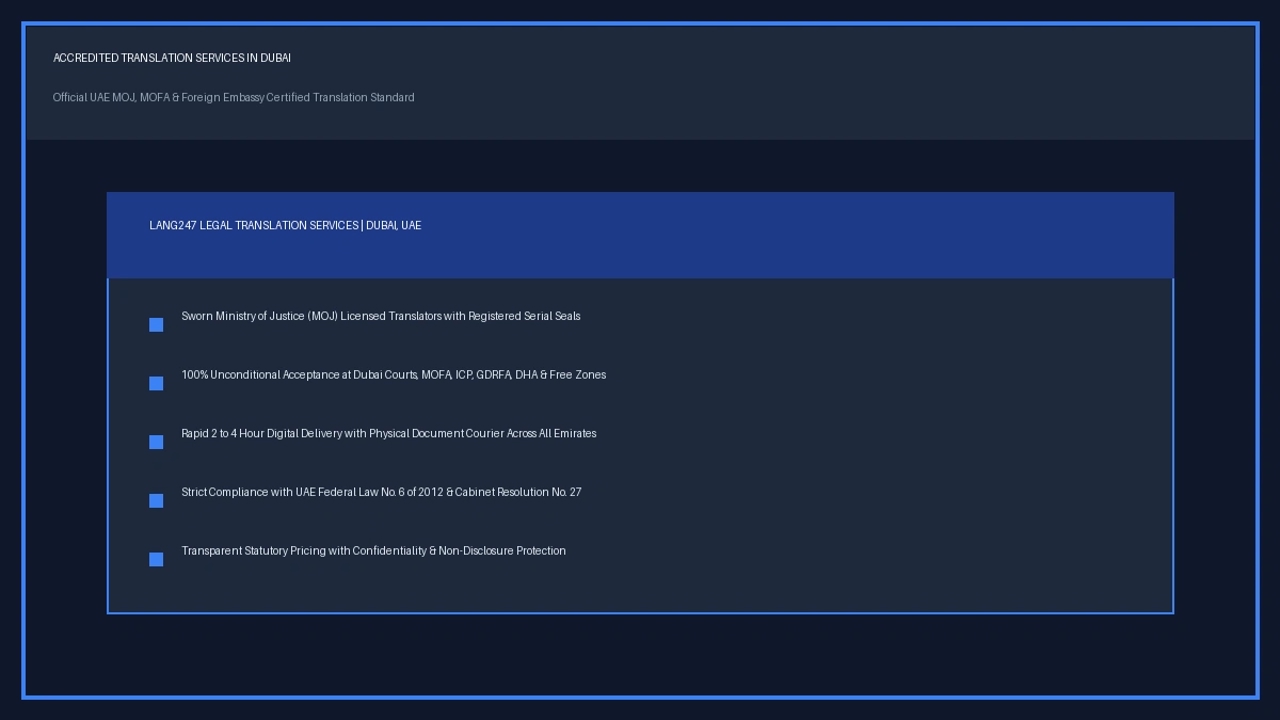
Under UAE Federal Law No. 6 of 2012 (Regulating the Profession of Translation) and Cabinet Resolution No. 27 of 2022, an accredited translation service in the United Arab Emirates is defined exclusively as a translation produced by a sworn legal translator licensed and certified directly by the UAE Ministry of Justice (MOJ). Any translation executed by unaccredited linguistic agencies or automated machine tools is legally void across all UAE ministries, courts, and foreign diplomatic missions.
- Statutory Benchmark: Official MOJ embossed or ink seal, unique federal registration license number, and bilingual certification statement.
- Acceptance Scope: 100% unconditional recognition across Dubai Courts, DIFC Courts, MOFA, Federal Authority for Identity (ICP), GDRFA, DHA, and all foreign embassies.
- Standard Turnaround: 2 to 4 hours digitally via Lang247; same-day physical courier dispatch across all UAE Emirates.
In an interconnected global financial capital like Dubai, multinational corporations, international litigators, expatriate professionals, and foreign diplomatic delegates continually process cross-border documentation. However, transitioning foreign-language legal deeds, court judgments, corporate statutes, and civil status certificates into the United Arab Emirates requires strict compliance with federal judicial mandates. Submitting foreign documentation without an accredited Ministry of Justice certified translation results in immediate administrative disqualification. Securing genuine accredited translation services in Dubai is the non-negotiable statutory standard required by all federal and emirate-level authorities.
Statutory Framework: UAE Federal Law No. 6 of 2012 Regulating Legal Translation
The regulatory scrutiny applied to foreign documentation in the United Arab Emirates is codified in explicit federal legislation. UAE Federal Law No. 6 of 2012 establishes the statutory obligations, ethical liabilities, and examination prerequisites required for linguistic practitioners. Under this statute, only individuals who have passed rigorous judicial examinations administered by the Ministry of Justice, accumulated verified courtroom translation experience, and sworn a formal oath of accuracy before the judicial bench are granted the title of Sworn Legal Translator.
When an MOJ-licensed legal translation agency certifies a statutory instrument, it affixes an official legal endorsement comprising:
- The official emblem and embossed seal of the UAE Ministry of Justice, displaying the translator's unique federal license registration code.
- A standardized bilingual legal affidavit certifying under criminal liability that the translation is an exact, unabridged, and faithful representation of the source document.
- The sworn translator's registered legal signature, date of execution, and formal contact information catalogued in the Dubai Courts judicial registry.
- A tamper-evident, standardized physical or cryptographic digital binding that irrevocably joins the certified translation to a verified copy of the original source instrument.
Under Article 28 of Federal Law No. 6 of 2012, any person or unregistered entity practicing legal translation without valid MOJ accreditation faces criminal prosecution, heavy financial sanctions, and mandatory commercial closure.
Accredited vs. Standard Certified Translation: Crucial Distinctions
In many Western legal systems (such as the UK, US, or Australia), a "certified translation" simply requires a statement of accuracy signed by a professional translator or certified by an industry association such as ATA or CIOL. However, in the civil law jurisdiction of the United Arab Emirates, general certified translations hold no legal standing in official government transactions.
| Evaluation Metric | Accredited MOJ Legal Translation (Lang247) | Standard / Non-Sworn Certified Translation |
|---|---|---|
| Regulatory Authority | UAE Ministry of Justice (Federal Judicial Mandate) | Commercial agency / Private trade association |
| Dubai Courts & Judicial Validity | 100% Admissible (Official evidentiary standing) | Inadmissible (Instantly rejected by judges) |
| MOFA Attestation Eligibility | Eligible for official Ministry of Foreign Affairs stamp | Ineligible for MOFA legalization |
| Foreign Embassy Acceptance | Accepted by European, Schengen, US, and UK diplomatic missions | High risk of visa rejection or delays |
| Translator Liability | Sworn criminal & civil judicial liability under UAE Penal Code | Limited or non-existent contractual liability |
Key UAE Ministries & Authorities Requiring Accredited Translation
Navigating the administrative ecosystem in Dubai requires presenting accredited translations across diverse governmental portals:
1. Dubai Courts & Ministry of Justice Federal Courts
Under the UAE Civil Procedures Law, Arabic is the sole official language of the judicial system. All foreign litigation filings, witness statements, commercial contracts, expert technical opinions, and powers of attorney presented before the Court of First Instance, Court of Appeal, or Court of Cassation must be translated into Arabic by an MOJ-sworn translator.
2. Ministry of Foreign Affairs (MOFA)
Documents originating outside the UAE—such as foreign corporate certificates, marriage records, educational diplomas, and police clearances—must undergo formal MOFA electronic attestation. MOFA counter officers will only stamp foreign documents accompanied by an MOJ accredited translation packet.
3. General Directorate of Residency and Foreigners Affairs (GDRFA) & ICP
Immigration authorities processing residency visas, family sponsorships, corporate employment visas, and 10-year Golden Visa files require accredited translations of foundational civil documents (birth certificates, marriage certificates, salary slips, and tenancy leases).
4. Dubai Department of Economy and Tourism (DET) & Free Zone Registries
Corporate entities establishing mainland branches or operating within free zones such as DMCC, DIFC, JAFZA, or DAFZ must present accredited translations of their Memorandum of Association (MOA), Certificate of Incorporation, Board Resolutions, and audited balance sheets. Learn more about official guidelines in our resource on Approved Translation Services in Dubai.
The Complete 5-Stage Attestation & Accreditation Pipeline
For international documents to attain full accredited standing in the United Arab Emirates, they must navigate a structured consular and linguistic sequence:
- Country of Origin Notarization: Verification by a licensed Notary Public or Solicitor in the issuing nation (e.g., UK, USA, Germany, India).
- Country of Origin Foreign Ministry Authentication: Legalization by the issuing nation's national department of foreign affairs (e.g., FCDO or US Department of State).
- UAE Embassy Consular Legalization: Consular verification at the diplomatic mission of the UAE in the issuing nation.
- UAE MOFA Inward Attestation: Electronic attestation via the UAE Ministry of Foreign Affairs portal upon arrival in Dubai.
- MOJ Accredited Sworn Legal Translation: Translation into statutory Arabic by Lang247 with official MOJ seal and digital serial verification.
Document Categories Requiring Accredited Legal Translation
Lang247's accredited translation desk handles the full spectrum of statutory documentation across commercial, civil, and regulatory categories:
- Corporate & Commercial Contracts: Cross-border joint venture agreements, shareholder pacts, commercial agency contracts, intellectual property assignments, and franchise covenants.
- Civil & Vital Status Documents: Marriage certificates, birth certificates, divorce decrees, adoption deeds, and police clearance certificates.
- Foreign Driving Permits: Complete RTA license exchange and conversion documentation. Explore our detailed statutory roadmap on Driving License Translation in Dubai.
- Specialized Language Services: For corporate enterprises from East Asia and Europe, explore our certified Chinese Translation Services in Dubai and our expert German Translation Services in Dubai.
Frequently Asked Questions (FAQ)
What makes a translation officially accredited in Dubai?
In Dubai and across the UAE, a translation is officially accredited only when executed by a sworn translator licensed directly by the UAE Ministry of Justice (MOJ). It must carry the translator's official embossed seal, registered federal license number, and bilingual certification affidavit.
Are translations from overseas agencies accepted by Dubai government departments?
No. UAE government authorities, Dubai Courts, and immigration portals reject translations produced by overseas agencies unless re-certified or executed by an MOJ-licensed legal translation agency based in the United Arab Emirates.
How fast can Lang247 complete an accredited translation?
Standard civil and commercial documents (up to 5 pages) are completed within 2 to 4 hours digitally. Urgent priority delivery is available for courtroom hearings and immediate visa deadlines, delivering certified files within 60 minutes.
Do I need to submit physical original documents to obtain an accredited translation?
In most instances, high-resolution digital scans submitted via our secure portal or corporate WhatsApp desk are fully sufficient. The certified translation packet clearly notes whether the translation was prepared from a verified original document or an authenticated digital copy.
Are Lang247 accredited translations accepted by foreign embassies in Dubai?
Yes. Our accredited translations are formatted to comply with the diplomatic specifications enforced by European, Schengen, UK, US, Canadian, and Australian embassies located in Dubai and Abu Dhabi for immigration, study, and citizenship applications.
Order Accredited Translation Services in Dubai Today
Get 100% MOJ-certified accredited legal translations accepted across all UAE courts, ministries, and embassies. Fast 2-hour digital delivery.