Academic Degree Certificate Legal Translation in Dubai: MOE & KHDA Equivalency Guide 2026
In the dynamic and rapidly expanding economy of the United Arab Emirates, expatriate professionals, international educators, medical specialists, and global corporate leaders continually relocate to Dubai to advance their careers and establish long-term residency. However, transitioning international academic credentials into the UAE's statutory framework requires navigating a rigorous multi-stage regulatory process. Whether you are applying for a specialized employment visa under the Ministry of Human Resources and Emiratisation (MOHRE), securing a 10-year Golden Visa as an executive director or PhD holder, obtaining professional licensure from the Dubai Health Authority (DHA) or Knowledge and Human Development Authority (KHDA), or seeking formal university degree equivalency from the UAE Ministry of Education (MOE), submitting your university degree without an accredited Ministry of Justice (MOJ) certified translation is a fatal mistake. To ensure unconditional official acceptance, securing an official academic degree certificate legal translation in Dubai is the non-negotiable statutory standard required by all federal and emirate-level authorities.
Understanding the UAE Ministry of Justice (MOJ) Sworn Translation Mandate
Unlike many Western jurisdictions where general certified translations from independent agencies are routinely accepted by municipal offices, the United Arab Emirates operates under a codified civil law framework governed by strict federal statutes. Under UAE Federal Law No. 6 of 2012 concerning the Regulation of the Profession of Translation, all foreign-language documents submitted to UAE federal ministries, judicial courts, free zone authorities, and government licensing departments must be officially translated into Arabic by a sworn legal translator licensed directly by the UAE Ministry of Justice (MOJ).
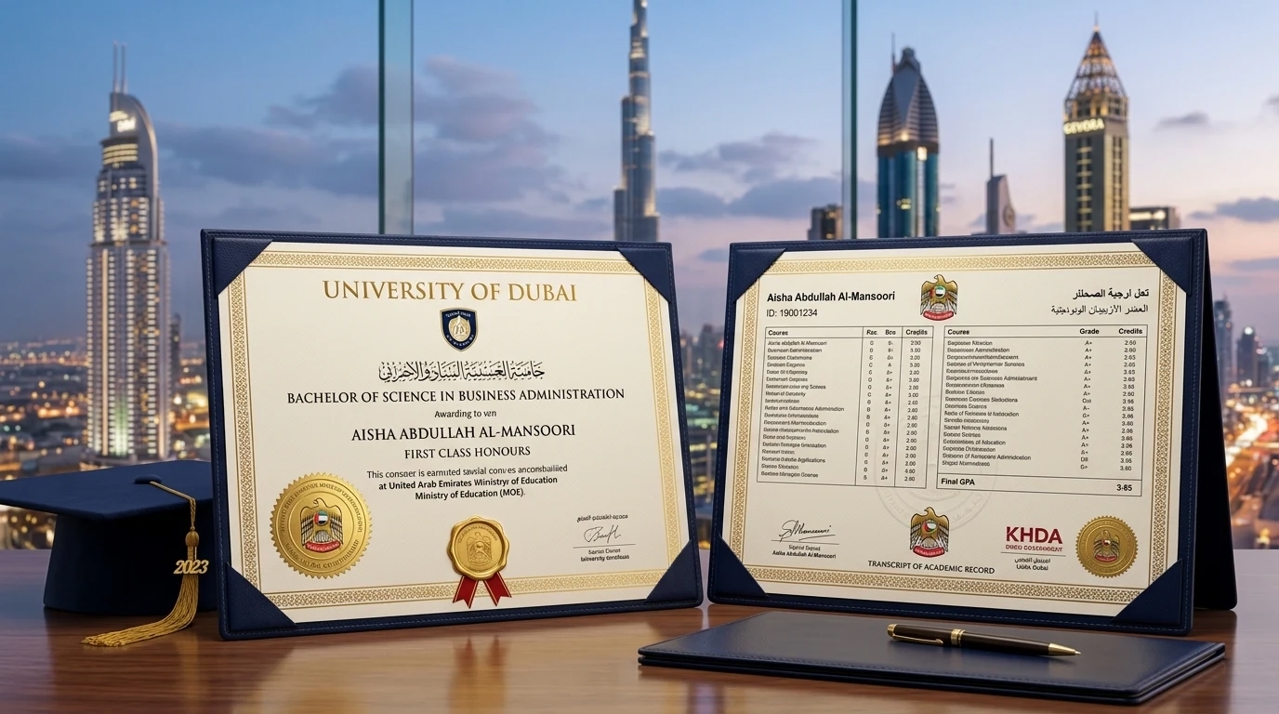
When an MOJ-licensed legal translator certifies an academic degree certificate or university transcript, they apply an official statutory endorsement that includes:
- The official embossed or ink seal of the UAE Ministry of Justice containing the translator's unique federal registration license number.
- The bilingual legal certification statement attesting that the Arabic translation is an exact, faithful, and unabridged rendition of the original foreign-language document.
- The translator's sworn signature, date of execution, and official firm contact credentials registered with the Dubai Courts and MOJ database.
- A standardized, tamper-evident binding mechanism that attaches the certified Arabic translation directly to a verified photocopy of the fully attested original degree certificate.
Any translation produced by an unaccredited translation bureau, an overseas non-sworn agency, or automated software tools such as Google Translate is legally null and void across all UAE administrative portals, resulting in instantaneous rejection by government case officers.
Statutory Framework: Federal Decree-Law No. 33 of 2021 and Cabinet Resolution No. 27 of 2022
The regulatory scrutiny applied to academic credentials in the United Arab Emirates is anchored in explicit federal labor and educational legislation. Under Federal Decree-Law No. 33 of 2021 on the Regulation of Labour Relations and Cabinet Resolution No. 27 of 2022, both employers and prospective employees face severe statutory liabilities if employment permits are procured on the basis of unverified or fraudulent academic credentials.
Article 65 of the UAE Labor Law establishes that submitting forged or altered documentation during the recruitment or licensing process results in immediate termination without notice, permanent labor bans across the UAE, and referral to the Public Prosecution for criminal forgery under the UAE Penal Code. Because human resources departments and public relations officers (PROs) bear institutional responsibility for regulatory compliance, corporate entities in Dubai mainland and free zones mandate that all foreign degrees be authenticated and legally translated into Arabic before submitting work permit applications to MOHRE or relevant free zone authorities (such as DMCC, DIFC, JAFZA, or DAFZ).
Key UAE Regulatory Authorities Requiring MOJ Degree Legal Translation
Academic credentials represent the cornerstone of professional qualification vetting across the United Arab Emirates. Several major federal and local authorities enforce mandatory legal translation protocols for foreign university diplomas:
1. UAE Ministry of Education (MOE) - Certificate Equivalency
The Ministry of Education oversees the formal Certificate Equivalency process, which confirms that a foreign university degree meets the academic and accreditation standards of the UAE national education framework. Certificate equivalency is mandatory for all individuals seeking employment in the UAE public sector, professional engineering registrations, academic teaching appointments, and Golden Visa applications under the specialized talent and doctoral researcher categories. The MOE portal strictly mandates that all degrees issued in languages other than Arabic or English must be accompanied by an MOJ-certified Arabic legal translation.
2. Knowledge and Human Development Authority (KHDA) - Dubai Educational Licensing
The KHDA regulates all private schools, universities, and training institutes in the Emirate of Dubai. To obtain an Educator Permit or academic teaching appointment in Dubai, prospective teachers and school leaders must submit their bachelor's degree in education, postgraduate certificate in education (PGCE), and academic transcripts. If these credentials originated in non-Arabic speaking nations, the KHDA teacher licensing portal requires sworn MOJ legal translations to confirm subject specialisms and pedagogical credit hours.
3. Dubai Health Authority (DHA) & Department of Health (DOH)
Healthcare professionals—including physicians, dentists, clinical pharmacists, nurses, and allied health specialists—must obtain professional practice licenses from the DHA (in Dubai) or the DOH (in Abu Dhabi). During the primary source verification (PSV) process managed through the DataFlow Group, medical degrees, residency completion certificates, and board fellowships must be legally translated to verify that clinical competencies comply with UAE Medical Licensing Board criteria.
4. Ministry of Human Resources and Emiratisation (MOHRE) - Skill Levels 1 & 2
Under the UAE labor classification framework, professional employment visas are categorized into distinct skill tiers. Skill Level 1 (Legislators, Managers, and Business Executives) and Skill Level 2 (Professionals in Scientific, Technical, and Humanistic Fields) require formal verification of a university degree. To ensure that an expatriate employee receives the correct occupational title on their UAE labor card and residence visa, companies must submit the employee's attested degree accompanied by an MOJ legal translation.
The Complete 5-Stage Attestation Chain Prior to Legal Translation
One of the most frequent misconceptions encountered by newly arriving expatriates in Dubai is the assumption that an academic degree can be translated immediately upon arrival. Under UAE statutory law, an academic degree certificate must undergo a formal, multi-stage consular attestation pipeline before the Ministry of Justice legal translation can be officially executed:
- Stage 1 (Country of Origin Notarisation / Verification): The original university degree diploma or official replacement copy must be verified by the issuing university registrar or certified as a true copy by a registered Notary Public or Solicitor in the issuing country (e.g., UK, USA, Canada, India, Australia).
- Stage 2 (Country of Origin Ministry of Foreign Affairs Legalisation): The notarized degree is submitted to the national department of foreign affairs or state department (e.g., the UK FCDO Legalisation Office, US Department of State, or Indian Ministry of External Affairs) to receive an official apostille certificate or government authentication stamp.
- Stage 3 (UAE Embassy Consular Attestation in Country of Origin): The legalised degree is presented to the diplomatic mission or embassy of the United Arab Emirates located in the issuing country (e.g., the UAE Embassy in London or Washington DC). The embassy verifies the foreign affairs stamp and applies its official consular stamp and QR-code security voucher.
- Stage 4 (UAE Ministry of Foreign Affairs - MOFA Electronic Attestation in Dubai): Upon arrival in the UAE, the document is submitted digitally via the official MOFA UAE portal (or physical customer happiness centre). MOFA issues an official electronic attestation confirmation sticker or QR-coded e-attestation certificate verifying that all diplomatic stamps are authentic.
- Stage 5 (Ministry of Justice - MOJ Certified Arabic Legal Translation): With the full attestation chain complete, an MOJ-licensed legal translation agency such as Lang247 translates the degree, university seals, and all preceding attestation stamps into Arabic, affixing the official MOJ sworn seal and binding the package for government submission.
Comprehensive Academic Credential Classification Matrix
Different types of educational documentation require nuanced translation and verification approaches depending on the end-use authority. The table below delineates the statutory handling required for each academic record classification:
| Academic Record Category | Issuing Institution | Primary UAE Use-Case | Mandatory Attestation Chain | MOJ Translation Requirements |
|---|---|---|---|---|
| Bachelor's Degree Diploma | Recognized University / College | MOHRE Skill Level 1/2 employment visas, company establishment, corporate bank accounts. | Full 5-stage chain: Notary → Foreign Affairs → UAE Embassy → UAE MOFA. | Full translation of Latin honors, degree title, major specialization, rector/chancellor signatures, and all consular stamps. |
| Master's & Doctoral (PhD) Diplomas | Accredited Postgraduate Institution | UAE Golden Visa (PhD holders), university professorships, MOE equivalency, executive leadership. | Full 5-stage chain, plus mandatory dissertation verification for MOE equivalency. | Comprehensive translation of thesis titles, academic disciplines, university council seals, and doctoral designations. |
| Academic Transcripts & Mark Sheets | University Office of the Registrar | MOE degree equivalency, KHDA teacher permits, DHA medical licensing, credit transfers. | Must be sealed and attested in parallel with the primary diploma certificate. | Rigorous word-for-word translation of every semester course title, credit weighting, GPA calculation, and grading key notes. |
| High School Diplomas (12th Grade) | Secondary Education Board / Ministry | UAE university admissions, MOHRE Skill Level 3/4 visas, police academy and aviation enrollments. | State/provincial board verification → National Foreign Affairs → UAE Embassy → UAE MOFA. | Translation of high school curriculum track (Science, Arts, Commerce), examination board seals, and total score percentages. |
| Professional Board & Medical Fellowships | Royal Colleges, Board of Examiners, ACCA | DHA / DOH consultant registration, judicial expert licensing, financial audit authorizations. | Professional body verification → National Legalisation → UAE Embassy → MOFA. | Meticulous translation of medical sub-speciality fellowships, board certifications, and statutory practice authorizations. |
Navigating the UAE Ministry of Education (MOE) Certificate Equivalency Portal
The Certificate Equivalency service provided by the UAE Ministry of Education operates via an integrated digital platform designed to ensure that foreign academic qualifications match the rigor of UAE higher education standards. To successfully navigate the MOE equivalency portal, applicants must prepare their academic documentation in strict adherence to the following procedural phases:
- Phase 1: Verification of University Institutional Recognition: Before submitting your equivalency request, verify that your awarding institution is listed on the official MOE recognized universities database or indexed in recognized international academic registries such as the UNESCO World Higher Education Database (WHED) or IAU registry. Qualifications from unaccredited or distance-only institutions without physical campus infrastructure may face additional scrutiny or denial.
- Phase 2: DataFlow Primary Source Verification (PSV): For certain specialized qualifications (especially in healthcare and engineering), the MOE requires a DataFlow PSV report. During this phase, DataFlow communicates directly with your university registrar to verify diploma issuance.
- Phase 3: Digital Document Lodgement on moe.gov.ae: Log into the MOE portal using UAE Pass. Upload high-resolution color scans of the fully attested degree diploma, complete academic transcripts, high school graduation certificate (if applying for bachelor's equivalency), and the official MOJ-certified Arabic legal translation issued by Lang247.
- Phase 4: Academic Committee Review and Equivalency Letter Issuance: The MOE academic accreditation committee evaluates the credit hours, syllabus coverage, and institutional ranking. Upon successful evaluation, an official digital Certificate of Equivalency featuring an encrypted verification QR code is issued directly to the applicant's profile.
Legal Nuances: Academic Transliteration and Arabic Naming Conventions
One of the most delicate challenges in executing MOJ-certified academic translations is the strict legal requirement regarding Arabic name transliteration. Under UAE residency laws, an expatriate's name in Arabic must perfectly match the Arabic spelling recorded in the Federal Authority for Identity, Citizenship, Customs and Port Security (ICP) database, their UAE Residence Visa, and their Emirates ID card.
When an uncertified or amateur translator transliterates a foreign name into Arabic using arbitrary phonetic spelling, discrepancies arise. For example, a name like "Stephen" could be transliterated as "ستيفن" or "ستيفان", while "Mohammed" can be spelled in multiple Arabic forms. If the Arabic name on your MOJ legal degree translation does not match the Arabic name printed on your Emirates ID, the MOE equivalency portal and MOHRE visa system will immediately flag the application as a name mismatch error.
At Lang247, our MOJ-sworn legal translators cross-reference the applicant's official passport, existing Emirates ID, or UAE entry visa before finalizing the Arabic transliteration, ensuring 100% nomenclature harmony across all government databases.
Detailed Real-World UAE Case Studies
Review these three representative case studies illustrating the critical role of MOJ degree legal translation across Dubai's corporate, educational, and healthcare sectors:
Case Study 1: Senior Executive Securing 10-Year UAE Golden Visa
The Scenario: A British corporate director relocated to Dubai to manage a multinational technology firm headquartered in Dubai Internet City. Earning a basic monthly salary exceeding AED 30,000, they applied for the UAE Golden Visa under the Executive Director category via the General Directorate of Residency and Foreigners Affairs (GDRFA).
The Evidentiary Challenge: GDRFA rules mandate that executive applicants must hold a bachelor's degree certified by the UAE Ministry of Education (MOE) equivalency. The applicant held a Bachelor of Science from the University of Manchester, which had been attested by the UK FCDO and UAE Embassy in London, but lacked the final MOFA e-attestation and MOJ legal translation.
The Solution: Lang247 facilitated the immediate UAE MOFA e-attestation, followed by a same-day MOJ-certified Arabic legal translation of the diploma and academic transcript. The translation package was submitted to the MOE Certificate Equivalency system, resulting in swift equivalency approval and the successful issuance of the 10-year Golden Visa.
Case Study 2: Canadian International Educator Securing KHDA Teacher Permit
The Scenario: A certified high school mathematics teacher from Toronto, Canada, accepted an appointment at a prestigious British curriculum international academy in Dubai. Prior to commencing employment, the KHDA required an official Educator Permit.
The Evidentiary Challenge: The applicant's Bachelor of Education diploma and four-year university transcripts originated from the University of Toronto. The KHDA licensing board required full Arabic legal translation of the 8-page transcript to verify curriculum instructional methodology credits.
The Solution: Lang247 executed an exhaustive, precise MOJ Arabic legal translation of the complete academic dossier, accurately rendering Canadian pedagogical credits into standard UAE educational terminology. The KHDA approved the Educator Permit within 48 hours of submission.
Case Study 3: German Specialist Physician Securing DHA Practice License
The Scenario: An orthopedic surgeon from Munich, Germany, was recruited by a private hospital in Dubai Healthcare City (DHCC). The Dubai Health Authority (DHA) licensing board required comprehensive verification of their German medical diploma (Approbationsurkunde), doctoral thesis certificate, and Facharzt specialist certificate.
The Evidentiary Challenge: German medical credentials feature complex Latin and Germanic administrative terminology that standard commercial translators frequently misinterpret, risking delays in medical licensing committee reviews.
The Solution: Lang247 deployed an MOJ-licensed translator specializing in medical jurisprudence who translated the entire dossier into Arabic and English. The DHA medical board accepted the translation without questions, granting full clinical practice credentials.
Common Mistakes Leading to UAE Degree Legal Translation Rejection
Government caseworkers in the UAE adhere to zero-tolerance compliance protocols. Avoiding these common mistakes will save you weeks of administrative delay and significant financial expenditure:
- Translating Before Completing the Attestation Chain: Submitting a degree for translation before obtaining the mandatory UAE Embassy and UAE MOFA attestation stamps. A legal translation cannot be back-dated to include attestation stamps added later; if you add stamps after translation, the entire translation must be redone.
- Translating Photocopies Without Verifying Originals: MOJ-licensed translators are strictly prohibited from certifying translations of unauthenticated photocopies. The original attested degree must be physically inspected or verified via cryptographically signed digital original PDFs.
- Omitting Backside Attestation Stamps in the Translation: Many applicants submit only the front face of their diploma. However, all consular stamps, apostilles, and MOFA electronic vouchers are affixed to the reverse side. The MOJ translation must translate every stamp, signature, and verification barcode on both sides.
- Disregarding Academic Subject Specialism Alignment: Inaccurate translation of academic degree majors (e.g., translating "Civil Engineering" in a manner that could be confused with "Architectural Engineering") can lead to rejection by the UAE Society of Engineers (SOE).
Frequently Asked Questions Regarding Degree Legal Translation in Dubai
Is an English translation of my university degree accepted by Dubai government authorities?
No. While English is widely used in commercial business throughout Dubai, the official statutory language of the UAE Government, courts, and ministries is Arabic. Under UAE Federal Law, all foreign-language educational credentials must be accompanied by an MOJ-certified Arabic legal translation.
Can I get my degree translated in my home country before traveling to Dubai?
While you can translate your degree overseas, translations executed outside the UAE are NOT recognized by UAE ministries unless they undergo reciprocal diplomatic attestation. The fastest, most cost-effective approach is to complete document attestation in your home country, and then obtain the official MOJ-certified Arabic legal translation directly in Dubai through an accredited firm like Lang247.
How long does an MOJ legal translation of a degree certificate take in Dubai?
Standard turnaround time for an MOJ-certified degree translation is typically 24 hours. For urgent visa or employment deadlines, Lang247 offers an expedited express service providing certified translations within 2 to 4 hours.
Does an MOJ degree legal translation expire?
No. Once an academic degree has been legally translated by an MOJ-licensed translator in Dubai, the certified translation does not have an expiration date. It remains permanently valid across all UAE government departments, provided the underlying document remains unmodified.
Do I need to translate my academic transcript in addition to my degree diploma?
For standard MOHRE employment visas, translating the main degree diploma is generally sufficient. However, for UAE Ministry of Education (MOE) Certificate Equivalency, KHDA teacher permits, and DHA medical licenses, the complete academic transcript must also undergo MOJ legal translation.
Can Lang247 assist with both UAE MOFA attestation and MOJ legal translation?
Yes. Lang247 provides comprehensive end-to-end processing, handling both the electronic and physical UAE MOFA attestation as well as the sworn Ministry of Justice (MOJ) Arabic legal translation in a unified, seamless workflow.
Secure Guaranteed MOJ Academic Legal Translation with Lang247 Dubai
Ensuring that your educational qualifications meet the exacting statutory standards of the UAE Ministry of Education, MOHRE, KHDA, and DHA is critical to your professional success in Dubai. At Lang247 Dubai, our team of Ministry of Justice sworn legal translators brings over a decade of specialized expertise in legalizing and translating academic diplomas, university transcripts, and medical fellowships across more than 150 languages. We guarantee 100% unconditional acceptance across all UAE federal ministries, free zone authorities, and judicial courts. Contact our Dubai legal translation team today to initiate your degree translation with complete peace of mind.